
Midazolam for stopping seizures
This leaflet is for parents and carers about how to use this medicine in children. Our information may differ from that provided by the manufacturers, because their information usually relates to adults. Read this leaflet carefully. Keep it somewhere safe so that you can read it again.
Never give your child more than one dose of Midazolam during one seizure unless you have been told to do this by your doctor.
Name of medicine
Midazolam buccal liquid
Brand names: Buccolam, Epistatus
Why is it important for my child to take Midazolam?
Midazolam is used to stop a seizure.
What is Midazolam available as?
Midazolam is available as buccal liquid medicine, which is given inside the cheek. There are two different products.
- Buccolam liquid medicine in prefilled oral syringes: 5 mg in 1 mL. This medicine is licensed for use in children.
- Epistatus liquid syrup in a bottle with 4 oral syringes: 50 mg in 5 mL. This medicine is not licensed for use in children but can be ordered specially from your pharmacist.
The Unlicensed Medicines leaflet explains the difference between licensed and unlicensed medicines.
When should I give Midazolam
You should give midazolam if your child’s seizure lasts more than 5 minutes. Follow these steps:

Do not give your child another dose of Midazolam unless you have been told you can by your doctor or nurse.
Do not give your child rectal diazepam or any other drug.
How much should I give?
Your doctor will work out the amount of Midazolam (the dose) that is right for your child. The dose will be shown on the medicine label.
It is normally the whole syringe full unless your doctor tells you otherwise.
It is important that you follow your doctor’s instructions about how much to give.
Do not give your child more than one dose of Midazolam during one seizure unless you have been told to do this by the hospital doctor.
How should I give Midazolam?
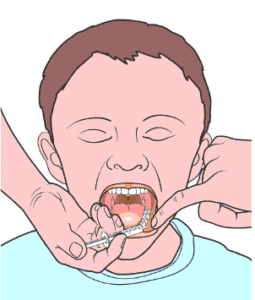
Seizure administration
- Midazolam needs to go into the space between the inside of the cheek and the teeth, which is called the buccal cavity. Your doctor or nurse will show you what to do.
- The medicine quickly gets from the cheek into the blood to stop the seizure. If you put the Midazolam into the middle of the mouth it will not work as well because it cannot get into the blood so quickly.
- Your child does not need to swallow the medicine. (It is not harmful if they do swallow it, but it will not work as well.)
What if my child is sick (vomits)?
Do not give your child another dose of Midazolam unless you have been told you can by your doctor or nurse.
Are there any possible side effects?
We use medicines to make our children better, but sometimes they have other effects that we don’t want (side effects).
Side effects you must do something about
Your child’s breathing may become a little shallow for a while. You do not need to worry about this. However, if you think your child is not breathing or if your child’s lips get a blue tinge, call an ambulance straight away.
Other side-effects you need to know about
Your child may be sleepy after having Midazolam. They
should have a sleep if they want to.Your child may be confused. They probably won’t remember having the seizure
There may sometimes be other side effects that are not listed above. If you notice anything unusual and are concerned, contact your doctor. You can report any suspected side effects to a UK safety scheme at mhra.gov.uk/yellowcard
Can other medicines be given at the same time as Midazolam?
- You must not give your child any other medicine to stop the seizure, unless your doctor has said that you can do this.
Is there anything else I need to know about this medicine?
Only give Midazolam to your child. Never give it to anyone else, even if they seem to be having a seizure, as this could do harm.
If you think someone else may have taken some Midazolam by accident, take them to hospital straight away.
- Make sure that your child always has their midazolam with them.
- Make sure that anyone who looks after your child knows what to do and how to give midazolam if your child has a seizure.
- It is best that your child always has the same brand of midazolam (Buccolam or Epistatus). Write down which brand you use, and how much you give. Keep this information with you.
- Make sure that the midazolam you have at home have not reached the ‘best before’ or ‘use by’ date on the packaging. Give old medicines to your pharmacist to dispose of.
Where should I keep this medicine?
- Keep the medicine in a cupboard, away from heat and direct sunlight.
- It does not need to be kept in the fridge.
- Make sure that children cannot see or reach the medicine.
- Keep the medicine in the container it came in.
Who to contact for more information?
Your child’s doctor, pharmacist or nurse will be able to give you more information about Midazolam and about other medicines used to treat epilepsy.
England: NHS 111
Tel 111
www.nhs.ukScotland: NHS 24
Tel 111
www.nhs24.scotNorthern Ireland: NI Direct
Wales: NHS 111 Wales
Tel 111
www.111.wales.nhs.ukEpilepsy Action
0808 800 5050
www.epilepsy.org.ukEpilepsy Society
01494 601 400
epilepsysociety.org.ukYoung Epilepsy
01342 831342
www.youngepilepsy.org.ukCopyright disclaimer
Version [2]. © NPPG, RCPCH and WellChild, all rights reserved. Review by May 2017.
The primary source for the information in this leaflet is the British National Formulary for Children. For details on any other sources used for this leaflet, please contact us through our website, www.medicinesforchildren.org.uk.
We take great care to make sure that the information in this leaflet is correct and up-to-date. However, medicines can be used in different ways for different patients. It is important that you ask the advice of your doctor or pharmacist if you are not sure about something. This leaflet is about the use of these medicines in the UK, and may not apply to other countries. The Royal College of Paediatrics and Child Health (RCPCH), the Neonatal and Paediatric Pharmacists Group (NPPG), WellChild and the contributors and editors cannot be held responsible for the accuracy of information, omissions of information, or any actions that may be taken as a consequence of reading this leaflet.