
Sodium valproate for preventing seizures
This leaflet is for parents and carers about how to use this medicine in children. Our information may differ from that provided by the manufacturers, because their information usually relates to adults. Read this leaflet carefully. Keep it somewhere safe so that you can read it again.
Do not stop giving Sodium valproate suddenly, as your child may have more seizures.
If your daughter has sex, it is essential that she uses contraception to prevent pregnancy as Sodium valproate can harm a developing baby.
Name of medicine
Sodium valproate (or valproic acid)
Brand names: Epilim, Episenta, Convulex
Modified-release: Epilim Chrono, Epilim Chronosphere, Episenta, Epival
Why is it important for my child to take Sodium valproate?
It is important that your child takes sodium valproate regularly so that they have fewer seizures. Seizures may also be called convulsions or fits.
What is Sodium valproate available as?
Tablets: 200 mg, 500 mg
Crushable tablets: 100 mg
Modified-release tablets: 200 mg, 300 mg, 500 mg
Capsules: 150 mg, 300 mg, 500 mg
Modified-release capsules: 150 mg, 300 mg,
Modified-release granules: 50 mg, 100 mg, 250 mg, 500 mg, 750 mg, 1 g
Liquid medicine: 200 mg in 5 mL; this may contain a small amount of sugar
When should I give Sodium valproate
Liquid, tablets and capsules that are not modified release:
- These are usually given twice each day: once in the morning and once in the evening. Ideally, these times are 10 - 12 hours apart, for example some time between 7 am and 8 am, and between 7 pm and 8 pm.
Modified-release tablets, capsules and granules (Epilim Chrono and Epival tablets, Episenta capsules, Episenta and Epilim Chronosphere granules):
- These are usually given once each day. This should be in the evening unless your doctor has told you to give it in the morning. These may sometimes be given twice a day.
Give the medicine at about the same time(s) each day so that this becomes part of your child’s daily routine, which will help you to remember.
How much should I give?
Your doctor will work out the amount of Sodium valproate (the dose) that is right for your child. The dose will be shown on the medicine label.
Your doctor will start your child on a low dose and then gradually increase it over a few days or weeks as your child gets used to the medicine and depending on how they respond to it. If you are not sure how much to give, check with your doctor, epilepsy nurse or pharmacist.
How should I give Sodium valproate?

Tablets
- Tablets must be swallowed whole with a glass of water, juice, or squash. Your child should not chew the tablet. Tablets should not be crushed.

Crushable tablets
- Crush the tablet and mix it with a small amount of soft food such as yogurt or a small cold drink. Your child should swallow it all straight away, without chewing it.
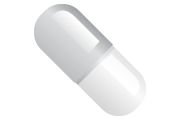
Episenta capsules
- These can be opened and the contents (granules) mixed with a small amount of soft food such as yogurt or jam or a small glass of water or squash. Do not crush the granules. Make sure your child swallows it all straight away, without chewing.
All other capsules
- Tablets must be swallowed whole with a glass of water, juice, or squash. Your child should not chew the tablet. Tablets should not be crushed.
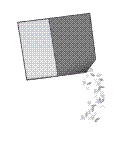
Granules
- Sprinkle or stir the granules into a small amount of soft food (e.g. yogurt) or a small drink. Your child should then swallow the food or drink straight away, without chewing. Make sure that they take it all.
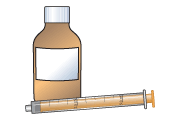
Liquid or syrup
- Shake the medicine well.
- Measure out the right amount using an oral syringe or a medicine spoon. You can get these from your pharmacist. Do not use a kitchen teaspoon as it will not give the right amount.
When should the medicine start working?
It may take a few weeks for Sodium valproate to work properly, so your child may still have their symptoms for a while. Continue to give the medicine as you have been told to by your doctor.
What if my child is sick (vomits)?
- If your child is sick less than 30 minutes after having a dose of Sodium valproate, give them the same dose again.
- If your child is sick more than 30 minutes after having a dose of Sodium valproate, do not give them another dose. Wait until the next normal dose.
If your child is sick again, seek advice from your family doctor, nurse, pharmacist, or hospital. They will decide what to do based on your child’s condition and the specific medicine involved.
What if I forget to give it?
If you usually give it once a day: Give the missed dose when you remember during the day, as long as this is at least 12 hours before the next dose is due. If you remember after this time, do not give the missed dose. Wait until the next usual dose.
If you usually give it twice a day: If you remember up to 4 hours after you should have given a dose, give your child the missed dose. For example, if you usually give a dose at about 7am, you can give the missed dose at any time up to 11am. If you remember after that time, do not give the missed dose. Give the next dose as usual.
Never give a double dose of Sodium valproate.
What if I give too much?
If you think you may have given your child too much Sodium valproate, contact your doctor or local NHS services (details at end of leaflet) or take your child to hospital. Have the medicine container or packaging with you, even if it is empty. This will be useful to the doctor.
Are there any possible side effects?
We use medicines to make our children better, but sometimes they have other effects that we don’t want (side effects).
Side effects you must do something about
If your child gets bad stomach pains or starts being sick (vomit) often, or both, take them to your doctor or hospital straight away. Your child may have a serious problem called pancreatitis.
Children occasionally get liver disease when taking Sodium valproate. If your child starts being sick every few hours, has stomach pains, is very sleepy, gets jaundice (the skin or eyes look yellowy) or has more seizures than usual, take them to a doctor or hospital straight away.
Your child’s hands may shake. Contact your doctor if this happens.
If you notice any unusual bleeding or bruising, contact your doctor.
Other side-effects you need to know about
Your child may get these side-effects when they first start taking sodium valproate. They will usually settle down within a week or so as their body gets used to the medicine. If you are concerned contact your doctor but continue to give sodium valproate to your child as usual.
- Your child may be unusually sleepy, or their behaviour may change.
- Your child may lose some hair. It will grow back, but it may be slightly curlier and darker than before.
Your child may be hungrier than usual – this effect can last for many months. Encourage your child to eat food that is low in fat and sugar, otherwise they may put on a lot of weight.
Your child may feel less hungry (lose their appetite), and feel sick (nausea) or be sick (vomit).
There may sometimes be other side effects that are not listed above. If you notice anything unusual and are concerned, contact your doctor. You can report any suspected side effects to a UK safety scheme at mhra.gov.uk/yellowcard
Can other medicines be given at the same time as Sodium valproate?
- You can give your child medicines that contain paracetamol or ibuprofen, unless your doctor has told you not to.
Check with your doctor or pharmacist before giving any other medicines to your child. This includes herbal and complementary medicines.
- Some other medicines used to treat epilepsy may affect how well Sodium valproate works, or may cause side-effects. If you are worried about side-effects, or if your child seems to be having more seizures, contact your doctor or epilepsy nurse.
Epilepsy and pregnancy
- Pregnancy presents a risk to both the mother with epilepsy and her unborn baby.
- If your daughter thinks that she may be pregnant, she should see her doctor as soon as possible but keep taking her medicine in the meantime.
Sodium valproate and pregnancy
- Women and girls taking sodium valproate should not become pregnant, because this medicine may harm the unborn baby.
- If your daughter is having sex, it is vital that she uses adequate contraception to prevent pregnancy. Your doctor or nurse will provide advice on the best types of contraception.
General advice about medicines
Advice about medicines for seizures
- If your doctor decides to stop a particular medicine, they will discuss this with you. They will usually reduce the dose bit by bit.
- It is best that your child always has the same brand of each medicine, as there may be differences between brands. Keep a record of which medicines your child has.
- If your child seems to have more seizures than usual, contact your doctor or your epilepsy nurse.
- Try to give medicines at about the same times each day, to help you remember.
- Only give this medicine to your child. Never give it to anyone else, even if their condition appears to be the same, as this could do harm.
- Make sure that you always have enough medicine. Order a new prescription at least 2 weeks before you will run out.
- Make sure that the medicines you have at home have not reached the ‘best before’ or ‘use by’ date on the packaging. Give old medicines to your pharmacist to dispose of.
Do not suddenly stop giving any medicines for seizures to your child. If you are worried, contact your doctor but carry on giving the medicine to your child as usual.
Do not change the dose of any medicine without talking to your doctor first.
If you think someone else may have taken the medicine by accident, contact your doctor straight away.
Where should I keep this medicine?
- Keep the medicine in a cupboard, away from heat and direct sunlight.
- It does not need to be kept in the fridge.
- Make sure that children cannot see or reach the medicine.
- Keep the medicine in the container it came in.
Who to contact for more information?
Your child’s doctor, pharmacist or nurse will be able to give you more information about Sodium valproate and about other medicines used to treat epilepsy.
England: NHS 111
Tel 111
www.nhs.ukScotland: NHS 24
Tel 111
www.nhs24.scotNorthern Ireland: NI Direct
Wales: NHS 111 Wales
Tel 111
www.111.wales.nhs.ukEpilepsy Action
0808 800 5050
www.epilepsy.org.ukEpilepsy Society
01494 601 400
epilepsysociety.org.ukYoung Epilepsy
01342 831342
www.youngepilepsy.org.ukCopyright disclaimer
Version [3]. © NPPG, RCPCH and WellChild, all rights reserved. Review by March 2023.
The primary source for the information in this leaflet is the British National Formulary for Children. For details on any other sources used for this leaflet, please contact us through our website, www.medicinesforchildren.org.uk.
We take great care to make sure that the information in this leaflet is correct and up-to-date. However, medicines can be used in different ways for different patients. It is important that you ask the advice of your doctor or pharmacist if you are not sure about something. This leaflet is about the use of these medicines in the UK, and may not apply to other countries. The Royal College of Paediatrics and Child Health (RCPCH), the Neonatal and Paediatric Pharmacists Group (NPPG), WellChild and the contributors and editors cannot be held responsible for the accuracy of information, omissions of information, or any actions that may be taken as a consequence of reading this leaflet.